
Pejman Moradi
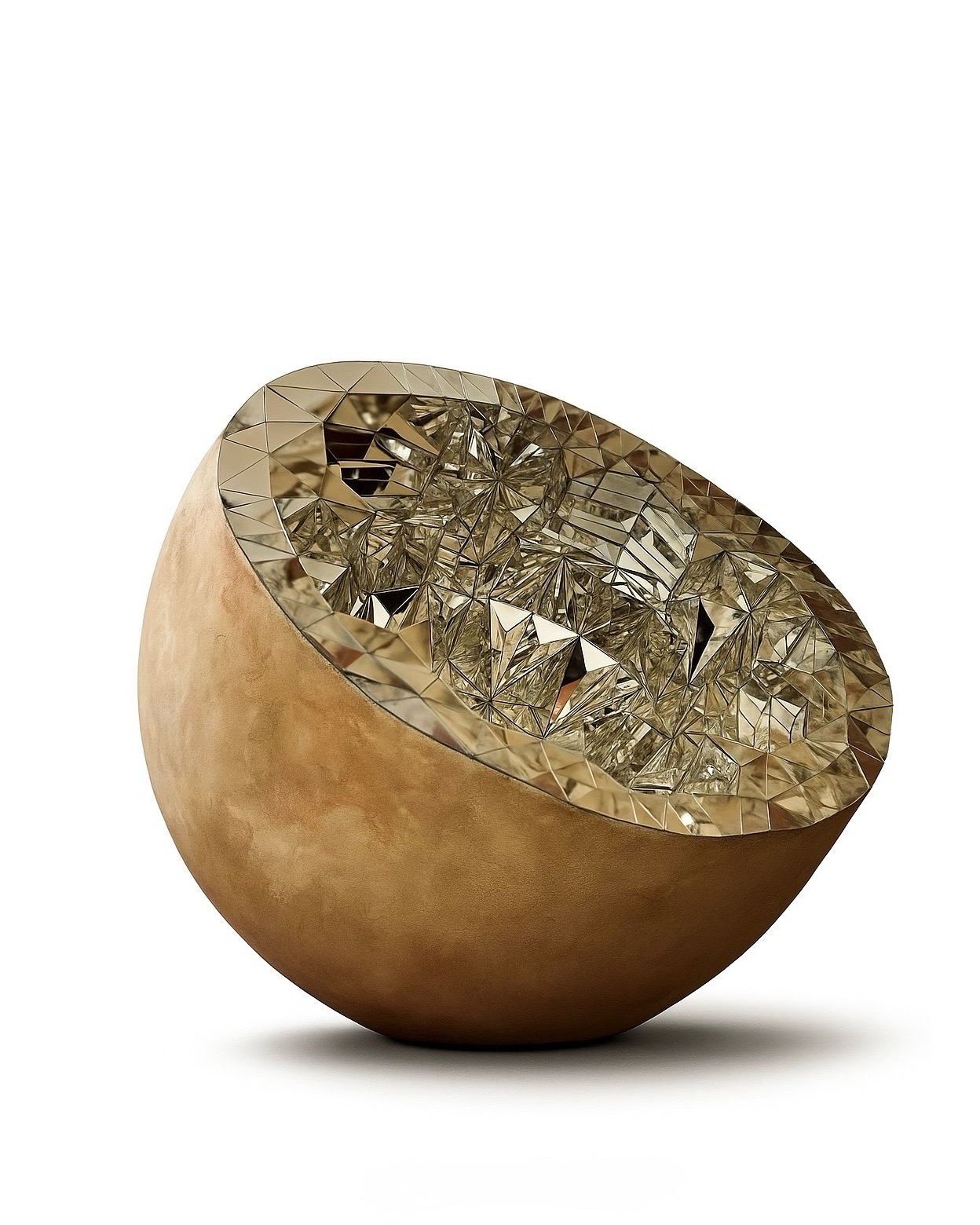
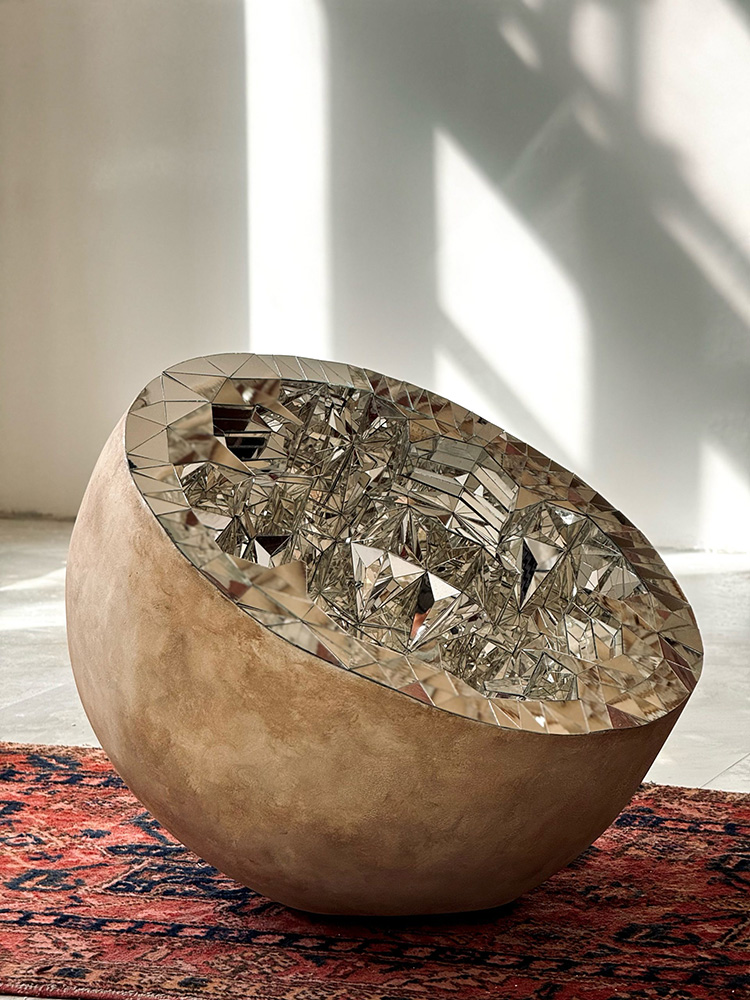
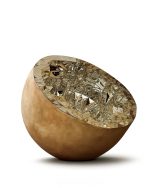
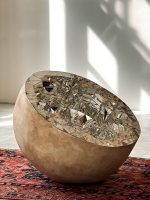
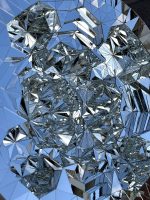
The Winking Crater, 2025
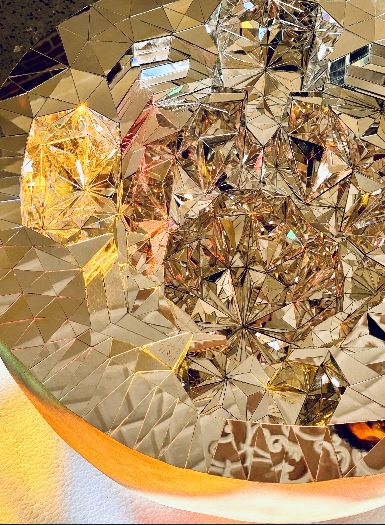
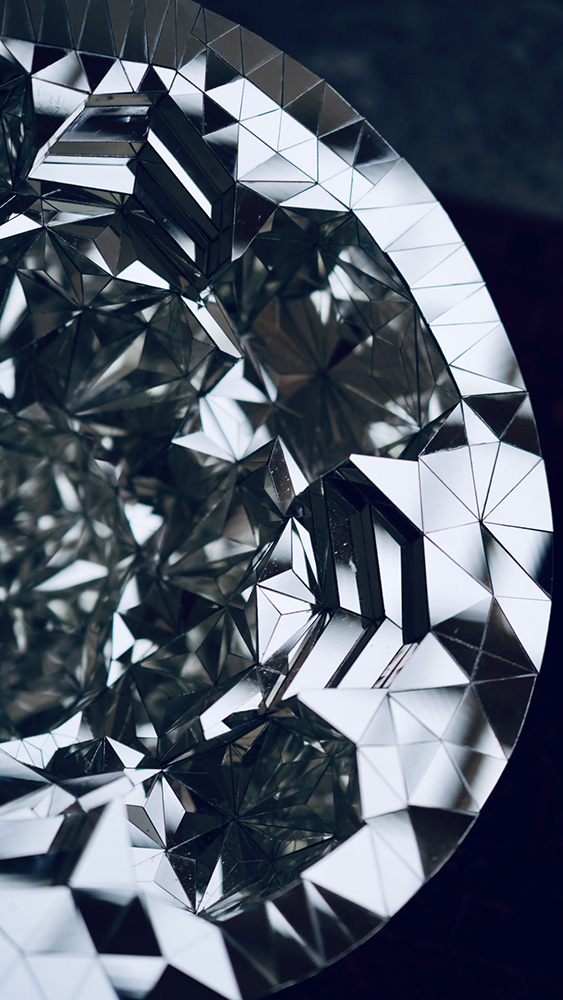
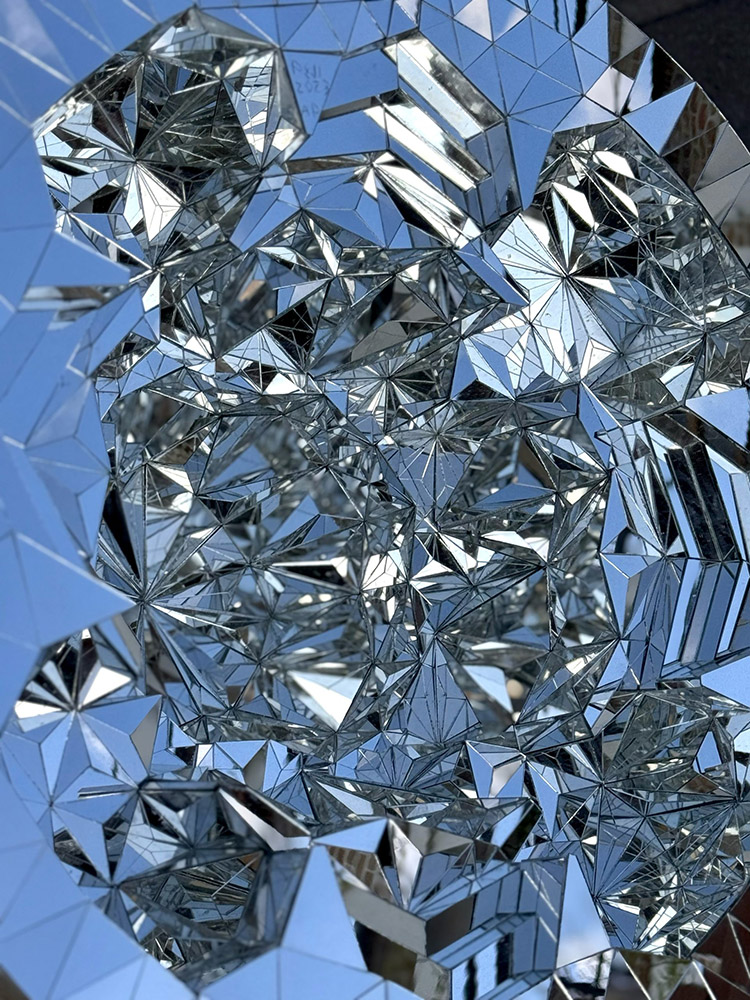
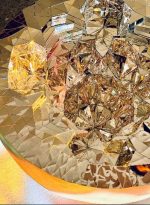
Mirror Working (Aynakari), Muqarnas, Fiberglass, Glass Mirror, Paint
60 × 60 × 50 cm
3670 CAD | 2290 € | 1980 £
$2,600.00 USD
 Available | – |
|---|
1 in stock
100% of proceeds go to the artist.
Certificate of Authenticity included.
Shipping timeline: approximately 3–6 months.
Payment details confirmed after inquiry.
Pejman Moradi (b. 1993, Sanandaj) is a Kurdish artist and designer working with sculpture and reflective media. Rooted in the architectural tradition of Aynakari (mirror work), his practice reinterprets this historic technique through contemporary geometric constructions. By assembling mirrored surfaces into precise yet destabilizing forms, Moradi alters the expected function of the mirror as a tool of clear reflection.
His works generate fragmented and shifting visual fields in which reflections multiply, intersect, and collapse into one another. This controlled disruption of perspective produces a state of perceptual instability, where no single viewpoint remains fixed. Within these environments, the viewer becomes both subject and object—simultaneously observing and being absorbed into the work.
Engaging with ideas of fractured identity and the psychological implications of self-perception, Moradi’s practice extends beyond formal experimentation. His mirror-based structures operate as spatial and conceptual devices that question how identity is constructed, reflected, and dispersed. Through this, he transforms a traditional decorative craft into a critical language addressing perception, presence, and the instability of the self.
Pejman Moradi’s sculptural forms are silent on the outside: opaque, earthy shells that reveal nothing of what lies within. A single opened face, however, is enough to disclose an interior that exceeds its container. Each mirrored facet passes light on to another, leaving the image nowhere to settle. The hemisphere, whose rounded form might have signified wholeness, has been cut open, exposing what it once concealed. This interior is intimate, but not tranquil; and only a gaze that bends over the form to look inside can traverse the distance between the tranquil exterior and the turbulent interior.
It is this act of bending that reveals the relationship between these works and tradition. In Iranian architecture, āineh-kāri (Mirror Works) and muqarnas are positioned above the viewer: beneath domes, in the semi-domes of iwans, and in the canopies of mihrabs.
These forms are intended to direct the gaze upward and orient the body toward the qibla—a body that knows where to stand and where to look. In Moradi’s work, the body slips out of this prescribed alignment. The dome, too, is inverted: the ceiling becomes a bowl, and what once extended overhead in a collective, ritual space is compressed into a small, enclosed object. The gaze that was meant to rise now turns downward and inward. If this inversion is not a rejection of tradition, it is a redirection of the body in relation to it. Moradi challenges tradition through its own means: he employs the technical mastery of āineh-kāri (Mirror Works) and muqarnas with precision, yet overturns their meaning. Here, the skill of tradition is turned against its own underlying logic. This is why the body and the act of seeing become central to his work: in ritual space, tradition prescribed where the eye should look; here, seeing becomes a bodily decision.
The mirror presents a unified image: in it, we see the body as a complete whole, even though our experience of the body is never so complete. This complete image is a template imposed on the body from the outside. Moradi’s use of āineh-kāri (Mirror Works) breaks this template apart. The mirror has been cut into countless fragments, and the face reflected in it appears not as a single image, but as fragments of several images—as if to suggest that an image can never hold the body together as a whole. Breaking this template also transforms the act of seeing. A unified image depends on a single point of view: a stationary eye looking from the front. In Moradi’s work, no such point exists. Each fragment is a window that reveals the body from a different angle, and with every movement, the arrangement of these windows changes.
Just as these works release the body from its prescribed form, they also release vision from its prescribed framework. In the tradition of āineh-kāri (Mirror Works), the mirror was never merely ornamental; the eye was tested against it, so that reflection would not be mistaken for reality. In Moradi’s work, this test is turned back upon the viewer. Expecting to see a complete image of themselves, viewers instead encounter scattered fragments. The complete image they had always seen of themselves, then, was not natural; it was a template instilled in them by tradition, one that collapses when tradition itself is inverted.
What takes its place is not disorder, but another way of seeing: a vision that moves among different facets and apertures without being bound to a predetermined definition. And if the “I” took shape through the unified image in the mirror, these mirrors propose another kind of “I”: one that is not given in advance, but formed through the coming together of multiple perspectives, each time anew. The precision of the artist’s hand is essential to this opening, for only a carefully measured order can produce such precisely calibrated disorder. A tranquil exterior and a turbulent interior. It is as though, in these works, seeing were always a form of belief, and every image that appears complete contained an interior we have yet to see.
ARTWORK PREPARATION
Every artwork is shipped according to its location.
For the safety of the artwork and to facilitate international transportation, works located in Iran are professionally rolled and packed in archival shipping tubes. Paintings on canvas are carefully removed from their stretcher bars prior to shipment and should be professionally re-stretched and framed upon arrival.
DELIVERY TIMELINE
Our current estimated delivery time for works shipped from Iran is 3–6 months, although some orders may arrive sooner depending on the availability of shipping arrangements.
Some artworks are already held by our partner galleries outside Iran and are available for immediate shipment. Where applicable, the artwork page will indicate Immediate Shipping Available, along with the Country of Dispatch.
SHIPPING COSTS & COORDINATION
Shipping is coordinated separately following the purchase of the artwork and is not included in the artwork price. Shipping costs, insurance, customs duties, and any applicable import taxes are the responsibility of the purchaser.
When the artwork is ready for dispatch, our team will contact the purchaser to coordinate shipment based on the shipping options available at that time. The applicable shipping cost will be communicated to the purchaser prior to shipment.
For complete details regarding shipping procedures, international logistics, customs, and purchaser responsibilities, please refer to our Shipping Policy.