Mojtaba Ghasemi
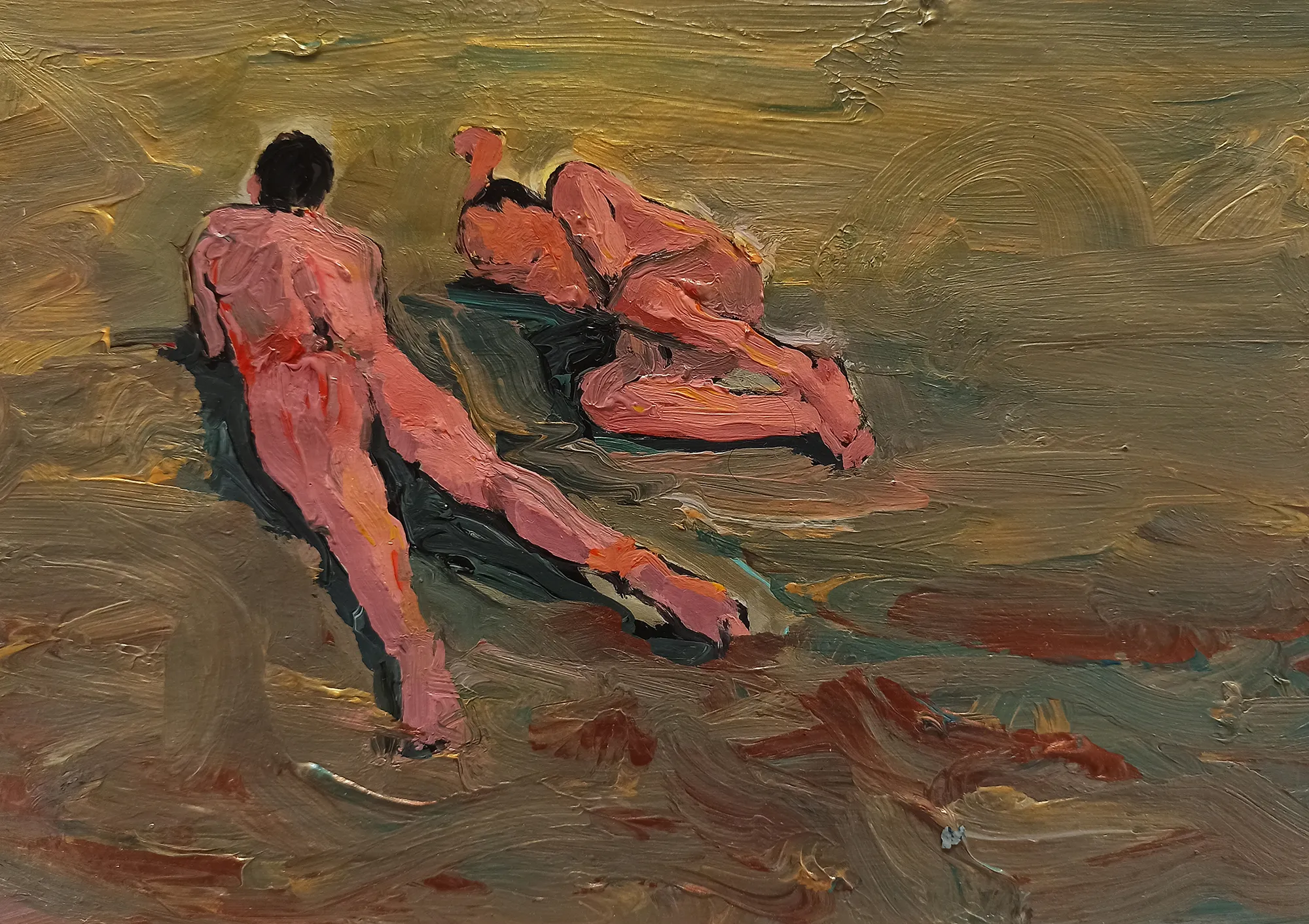
Untitled, 2020
Acrylic on Cardboard
25×35 cm
733 CAD | 458 € | 395 £
$520.00 USD
 Available | – |
|---|
1 in stock
100% of proceeds go to the artist.
Certificate of Authenticity included.
Shipping timeline: approximately 3–6 months.
Payment details confirmed after inquiry.
Mojtaba Ghasemi (1987, Bandar Anzali), residing and working in Iran. He earned his degree in graphic design from the University of Tehran.
He has had the privilege of a decade-long partnership with Dastan Gallery, renowned as one of Iran’s foremost contemporary art institutions. At present, he is collaborating with his brothers within the framework of an art collective known as Ghasemi Brothers, as they prepare for an upcoming exhibition at Dastan Gallery.
The predominant theme of his artworks typically revolves around nude figures set against the backdrop of nature. The bare human form serves as a wellspring of inspiration and passion that drives his creative process. However, given Iran’s deeply rooted traditional and religious values, there have been numerous constraints imposed on both the display and creation of his preferred subject matter. Living within this environment has inadvertently, and at times intentionally, led to a degree of self-censorship.
At first glance, Mojtaba Ghasemi’s paintings appear to depict boys and young men resting and playing on the beach. They are works characterized by loose, expressive brushstrokes, situated within the post-Impressionist tradition initiated by Cézanne. Beautiful paintings that seemingly present the viewer with a simple and familiar scene. But is that all there is to them? It is not.
Rather than speaking about a familiar and readily accessible landscape, Mojtaba Ghasemi speaks of nakedness as a state of being-with-oneself, rather than nudity as a state of being-for-another.
The naked body he depicts is simply itself, in its natural and spontaneous state; not the nude body that has been arranged and presented to be seen by another—a body transformed into an object of the gaze. In Ghasemi’s paintings, this distinction is not merely an abstract idea; it emerges from the very composition of the works. The figures are mostly not facing the viewer: some have their backs turned, some have turned their heads away, while others conceal their faces in shadow or in the embrace of a companion. If the classical genre of the nude is organized around the visibility of the body to an external observer—a body arranged in order to be seen—the compositions here do not operate in this way. The body has not been arranged for visibility; its nakedness is presented as the natural condition of the body.
The physical boundaries of the body, too, lose their certainty in these works. Loose brushstrokes and colors that intermingle the skin with ochre sand and turquoise water render the body not as a distinct and foregrounded object for display, but as part of a continuum of the surrounding environment. Here, the body is not pulled out of the background in order to draw attention to itself; on the contrary, it dissolves and is absorbed into it. The depiction of the male nude as the natural condition of the body also carries historical, political, and social implications. The Islamic Revolution reached Anzali, Ghasemi’s hometown, later, but for people who had experienced the beach, sunlight, and bodily freedom for years, its impact was more intense and restrictive.
The presence of the body, both female and male, was suddenly erased and removed from the public sphere. Yet this erasure did not continue in the same way for both genders: the female body remained confined by restrictions on dress and formal segregation, while the male body, although also deprived of unrestricted access to sunlight and water, gradually found a way back to those same shores—though no longer with the same carefree ease of the pre-revolutionary period, but under the shadow of surveillance and caution.
Ghasemi, himself a product of this city and this shoreline, seems in these paintings to be painting a memory that was never entirely erased from the bodies of the people of Anzali. His generation did not witness the free body firsthand, but inherited its traces through stories, family photographs, and the longing of the generations that came before. The painting of these tranquil figures is not a nostalgic reconstruction of a lost past, but a quiet, unadorned assertion of a right that never fully surrendered: the body’s right to simply be, here and now.
ARTWORK PREPARATION
Every artwork is shipped according to its location.
For the safety of the artwork and to facilitate international transportation, works located in Iran are professionally rolled and packed in archival shipping tubes. Paintings on canvas are carefully removed from their stretcher bars prior to shipment and should be professionally re-stretched and framed upon arrival.
DELIVERY TIMELINE
Our current estimated delivery time for works shipped from Iran is 3–6 months, although some orders may arrive sooner depending on the availability of shipping arrangements.
Some artworks are already held by our partner galleries outside Iran and are available for immediate shipment. Where applicable, the artwork page will indicate Immediate Shipping Available, along with the Country of Dispatch.
SHIPPING COSTS & COORDINATION
Shipping is coordinated separately following the purchase of the artwork and is not included in the artwork price. Shipping costs, insurance, customs duties, and any applicable import taxes are the responsibility of the purchaser.
When the artwork is ready for dispatch, our team will contact the purchaser to coordinate shipment based on the shipping options available at that time. The applicable shipping cost will be communicated to the purchaser prior to shipment.
For complete details regarding shipping procedures, international logistics, customs, and purchaser responsibilities, please refer to our Shipping Policy.