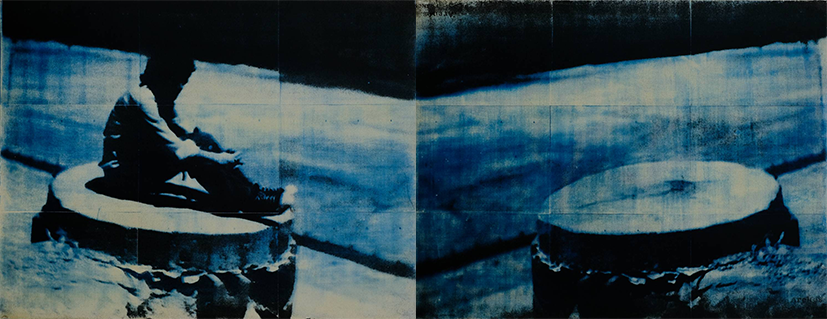
Mina Hassani
STILLNESS, 2025
Gum-oil printing, Cyanotype Printing On Arches Cardboard
144 × 55 cm
Unique
1142 CAD | 713 € | 616 £
$810.00 USD
 Available | – |
|---|
1 in stock
100% of proceeds go to the artist.
Certificate of Authenticity included.
Shipping timeline: approximately 3–6 months.
Payment details confirmed after inquiry.
Mina Hassani is a Tehran-based artist and a graduate of Persian Literature. Her artistic practice explores the themes of memory, recollection, and time. Utilizing family archival materials through various hand-printing techniques and alternative photography, she investigates the intricate relationship between the present/future and the forgotten past. For Hassani, the past serves as a fundamental benchmark to navigate and define the coordinates of contemporary humanity in the face of the future.
Mina Hassani is a conceptual artist whose practice engages with themes of memory, collective memory, trauma, mourning, embodiment, and forgetting. Working primarily with hand-printmaking and alternative photographic processes, she has developed a substantial body of work through printmaking. For Hassani, print is not merely a means of reproducing an image; it is a way of summoning and narrating—of bringing something back into presence, again and again, while opening up different conceptual dimensions of the subject at hand. Her background in literature has also made storytelling a central element of her practice.
The three works presented by Mins as part of the Continuum initiative, as their title suggests, address the stillness and perpetual suspension of a figure within the frame of a photograph—originally a family photograph—and explore the shifting conditions of the subject’s presence and absence within space. The residual colors of gum bichromate and cyanotype, together with the figure’s indistinctness, evoke the nature of memory: a memory sufficiently clear to retain details, yet sufficiently blurred for those details to elude precision; a memory always vulnerable to alteration, in which the original subject may gradually disappear from the frame and slip into forgetting. Within this tension, Hassani approaches presence and absence not as opposing states, but as two sides of the same condition. The figure’s presence already contains the trace of its future absence, while absence is never entirely empty: it preserves traces of a former presence—in color, in blurring, and in the residue of exposure—on the surface of the frame. The family photograph thus becomes a threshold, a space in which the figure is neither fully present nor entirely gone, but suspended between remembering and forgetting. Yet the work extends beyond the memory of a family photograph and the presence and absence of a blood relative. In particular, the principal figure in one of the works has been deliberately rendered to evoke a face that, for many Iranians, has become an iconic and unforgettable image: Khodanour. Hassani heightens this association through a considered interplay of vertical lines, bringing the resemblance more insistently to the surface of the image. The lines, alongside the figure, seem to facilitate an act of recognition while simultaneously summoning the collective memory attached to this face. The presence of the sea and water further intensifies this association.
Water holds a fundamental place in Hassani’s practice. It is witness, testimony, and narrator; at times, within these works, it becomes an extension of the artist herself, assuming the role of witness and narrator to what has happened to the figure. Presence and absence therefore emerge not as opposing conditions, but as two sides of the same coin. As the figure fades, the landscape and water—despite their own fluidity and continual transformation—assume its place as witnesses, bearing a record of the figure’s having been there. Absence, in Hassani’s work, is thus not the negation of presence, but its inverted form: not the end of the narrative, but another way in which the narrative persists.
ARTWORK PREPARATION
Every artwork is shipped according to its location.
For the safety of the artwork and to facilitate international transportation, works located in Iran are professionally rolled and packed in archival shipping tubes. Paintings on canvas are carefully removed from their stretcher bars prior to shipment and should be professionally re-stretched and framed upon arrival.
DELIVERY TIMELINE
Our current estimated delivery time for works shipped from Iran is 3–6 months, although some orders may arrive sooner depending on the availability of shipping arrangements.
Some artworks are already held by our partner galleries outside Iran and are available for immediate shipment. Where applicable, the artwork page will indicate Immediate Shipping Available, along with the Country of Dispatch.
SHIPPING COSTS & COORDINATION
Shipping is coordinated separately following the purchase of the artwork and is not included in the artwork price. Shipping costs, insurance, customs duties, and any applicable import taxes are the responsibility of the purchaser.
When the artwork is ready for dispatch, our team will contact the purchaser to coordinate shipment based on the shipping options available at that time. The applicable shipping cost will be communicated to the purchaser prior to shipment.
For complete details regarding shipping procedures, international logistics, customs, and purchaser responsibilities, please refer to our Shipping Policy.