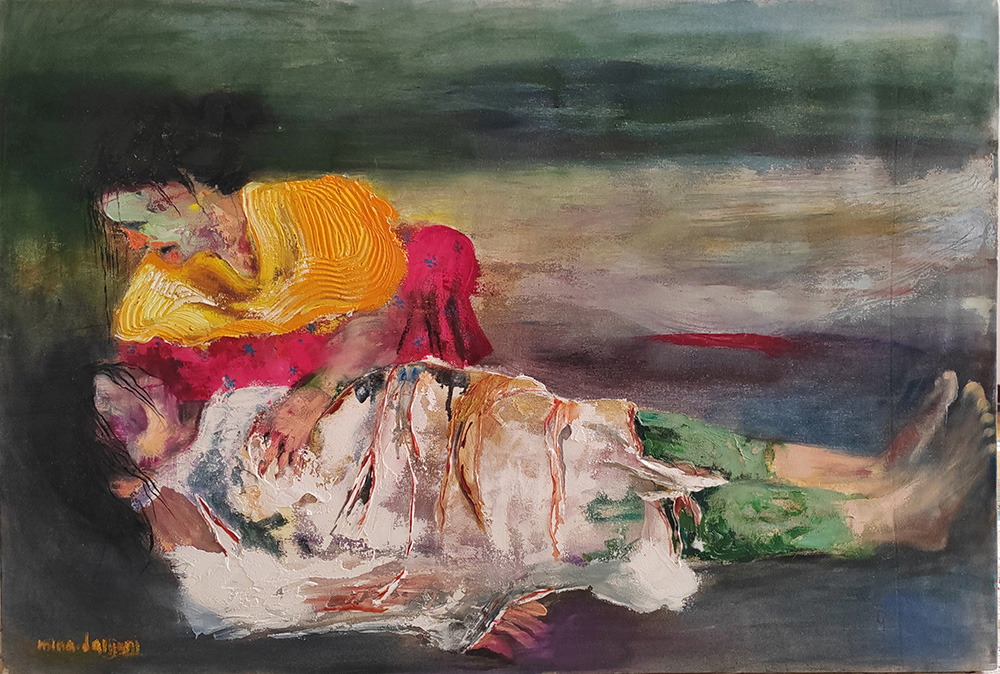
Mina Darijani
Untitled, 2022
Oil on Canvas
73 × 108 cm
600 CAD | 370 € | 320 £
$425.00 USD
 Available | – |
|---|
1 in stock
100% of proceeds go to the artist.
Certificate of Authenticity included.
Shipping timeline: approximately 3–6 months.
Payment details confirmed after inquiry.
Mina Darijani is a visual artist born in 1367 (1988/1989) in Bam, Iran. Her works focus on lived human experience and its relation to social structures, and through a sociological perspective she explores concepts such as loneliness, isolation, memory, instinct, and the impact of collective events on the individual psyche. Her creative process is rooted in improvisation, where matter, color, and movement become part of the work’s conceptual thinking. In Darijani’s practice, color is not merely a visual element but a psychological medium for conveying emotion and experience. She seeks to question the boundaries between the individual and the collective, nature and human, as well as the external reality and the inner world.
Mina Darijani is a painter whose work is marked by a form of dissent that does not take the shape of a direct political statement, but rather emerges as a dissatisfaction with the human condition and with the constraints that life and the world impose upon us. Her works can be understood as the course of a sustained search: a search for a form of liberation from these constraints. They are not merely external. They are rooted in being human itself, in instincts that civilized life has inevitably had to restrain, and for which the human being pays the price through a persistent, unnamed discontent. In this painter’s world, the human being is less the author of their own history than exposed to forces that leave nothing behind but wounds.
Faced with such a world, liberation does not mean moving forward, but returning: releasing the human body, seeking refuge in nature—a place that is no longer merely a location, but the final domain of instinct and being alive. This impulse toward a kind of pre-civilized primitivism—or, more precisely, a movement toward instinctual roots and a return to origins—appears to be one of the paths she passionately pursues.
This search for simplicity does not remain simple at the level of the works themselves. Darijani’s drawing is restrained. Her figures are compact, almost unified masses, generally turned toward the viewer or withdrawn into themselves, while their contours dispense with anatomy and perspectival depth to the extent that is necessary.
The complexity of the works emerges elsewhere: in color. The backgrounds are often broad, flat, saturated fields of red, green, yellow, blue, or orange. Against these expanses, the bodies of the figures are constructed through layer upon layer of dry, scraped strokes—a darkness that appears black from a distance, but reveals itself up close as an amalgam of blue, violet, red, and pink. Color in these works does not bear the burden of description. A figure may be entirely blue or violet, while a small mark of red or yellow can set the entire composition into vibration. If drawing holds the skeleton of the image in place, color is the realm in which instinct is given room to emerge; a space in which color is no longer subordinate to the depiction of the body, but becomes a physical and affective force in its own right.
The liberation Darijani seeks in this return to primitivism brings with it a particular set of signs and symbols, one of the clearest being the mouth. The mouth is the first place through which the animal encounters the world, and the last place in which the animal remains within the human: the same organ that devours also speaks. Perhaps becoming human was nothing more than moving the mouth from hunger toward language, while civilization has fashioned a face with a closed, composed, and self-controlled mouth. In Darijani’s works, the mouth relinquishes this composure. At times, it returns to its primal domain and does nothing but devour, as though eating takes the place of every form of dialogue.
At other times, it remains concealed and silent in mourning or shame, from which neither a scream nor a word can emerge. In these paintings, the mouth is no longer the site of language; it is the site of hunger, silence, and refusal.
And it is here that the return to primitivism encounters its own difficulty. A mouth that has relinquished language has not yet returned to the innocence of eating. The mouth remains suspended between hunger and speech; between the animal that devours and the human being who speaks. It is here that the return to the root becomes impossible: even in the desire to return, the human being can no longer relinquish what they have become.
ARTWORK PREPARATION
Every artwork is shipped according to its location.
For the safety of the artwork and to facilitate international transportation, works located in Iran are professionally rolled and packed in archival shipping tubes. Paintings on canvas are carefully removed from their stretcher bars prior to shipment and should be professionally re-stretched and framed upon arrival.
DELIVERY TIMELINE
Our current estimated delivery time for works shipped from Iran is 3–6 months, although some orders may arrive sooner depending on the availability of shipping arrangements.
Some artworks are already held by our partner galleries outside Iran and are available for immediate shipment. Where applicable, the artwork page will indicate Immediate Shipping Available, along with the Country of Dispatch.
SHIPPING COSTS & COORDINATION
Shipping is coordinated separately following the purchase of the artwork and is not included in the artwork price. Shipping costs, insurance, customs duties, and any applicable import taxes are the responsibility of the purchaser.
When the artwork is ready for dispatch, our team will contact the purchaser to coordinate shipment based on the shipping options available at that time. The applicable shipping cost will be communicated to the purchaser prior to shipment.
For complete details regarding shipping procedures, international logistics, customs, and purchaser responsibilities, please refer to our Shipping Policy.