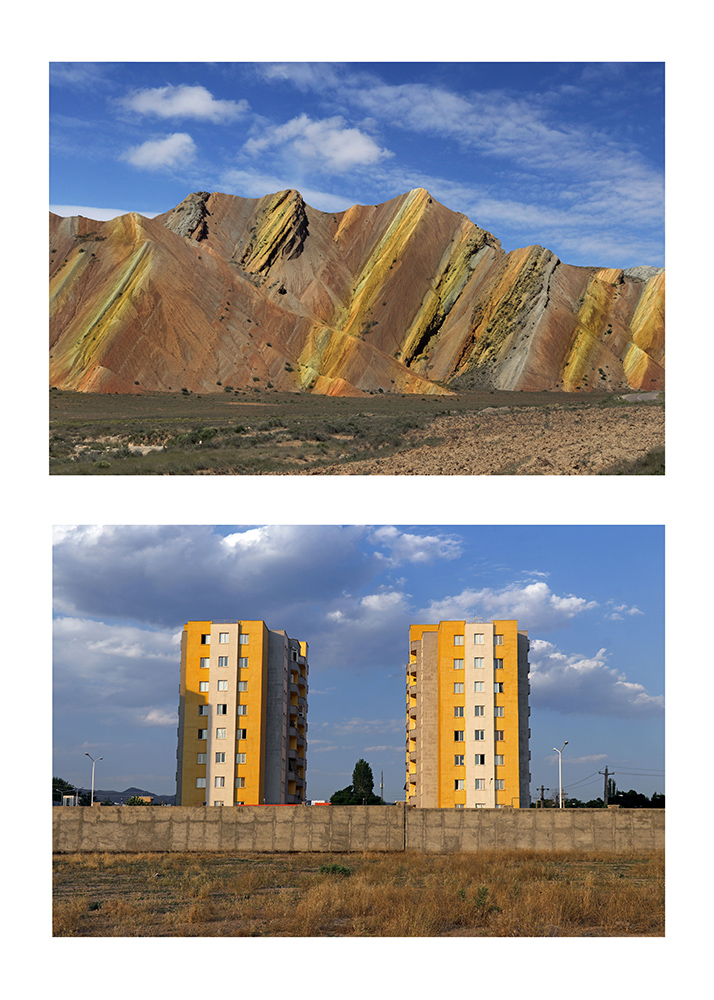
Mehrdad Fathi
Alabula, 2019
Digital Photography
50 ×70 cm
Edition 1/5
1130 CAD | 700 € | 610 £
$800.00 USD
 Available | – |
|---|
1 in stock
100% of proceeds go to the artist.
Certificate of Authenticity included.
Shipping timeline: approximately 3–6 months.
Payment details confirmed after inquiry.
Mehrdad Fathi (b. 1995) was born in Zanjan, Iran, where he continues to live and work. He holds a Master’s degree in Architecture and began his artistic practice in photography in 2013.Working primarily in conceptual and idea-driven photography, Fathi has developed a body of work shaped by his background in architecture. His projects often engage with themes related to space, the built environment, and the subtle relationship between humans and their surroundings. Through a thoughtful and research-oriented approach, he explores architectural contexts not merely as physical structures, but as carriers of social and conceptual meaning.His works have been presented in solo exhibitions in Iran and in various group exhibitions both nationally and internationally.
Mehrdad Fathi holds a degree in architecture, and his architectural understanding informs his photographic practice. His work is primarily concerned with place, the environments that surround human life, and urban space. The works featured in the Continuum initiative were selected from his Alabola series.
In each diptych, the Alabula series (meaning “colorful”) places a natural formation (above) in relation to a human-made structure (below). In the upper half, the mountains, with their layers of color, embody what the tradition of landscape painting has termed the sublime. In the lower half, residential complexes repeat those same colors across their façades, but according to an entirely different logic: one of repetition, calculation, and limitation.
Only color has been transferred from the sublime to these buildings. Thus, while color in the mountains is an expression of matter itself, in the buildings it becomes a coating applied to the surface, and the sublime is reduced to ornament. Landscape paintings that document human-made environments have generally turned toward the mundane by setting the sublime aside. This series, by contrast, holds both within a single frame, making the distance between them visible through their juxtaposition. What emerges from this confrontation is the human-made structure’s attempt to borrow from the sublime—an attempt that fails at the very moment of resemblance, because the only thing that can be borrowed from the sublime is its surface. These buildings stand not within the city but at its edge. A strip of land always separates them from the viewer. This land is neither quite city nor landscape anymore.
It is an abandoned, indeterminate terrain, excluded from the city’s functional circuits; this very exclusion signals both absence and anticipation. The mountains, too, lie beyond a strip of land. It is as though both orders—the sublime and the human-made—are viewed from the same threshold. The frontal, horizon-level perspective presents the buildings less as dwellings than as façades laid out before the eye. This is the gaze that emerges from the photographer’s architectural sensibility. From this perspective, Alabula is less about nature versus architecture than about the moment when the city becomes landscape. The city’s edge is where this encounter becomes visible, because there the sublime has not entirely disappeared, nor has the human-made structure fully found its place.
Yet this chromatic resemblance can also be read from another perspective. When blending into one’s surroundings goes too far, it no longer offers a means of concealment. Instead, it becomes a process through which a being defines itself by reference to coordinates external to itself, dissolving the boundary between what it is and what surrounds it. In Alabula, this resemblance is not one-sided. The buildings have taken on the colors of the mountains, while the mountains, beside them, begin to resemble constructed façades through their bands of color. In this likeness, both lose something of their identity: the mountain is no longer entirely sublime, and the building is no longer entirely human-made. The boundary separating the two halves of the frame fades within their shared palette. It is as though this dissolution of boundaries were not an exceptional event but a natural process in our lives, much as boundaries in many other domains have gradually blurred, leaving us uncertain where one ends and the other begins.
ARTWORK PREPARATION
Every artwork is shipped according to its location.
For the safety of the artwork and to facilitate international transportation, works located in Iran are professionally rolled and packed in archival shipping tubes. Paintings on canvas are carefully removed from their stretcher bars prior to shipment and should be professionally re-stretched and framed upon arrival.
DELIVERY TIMELINE
Our current estimated delivery time for works shipped from Iran is 3–6 months, although some orders may arrive sooner depending on the availability of shipping arrangements.
Some artworks are already held by our partner galleries outside Iran and are available for immediate shipment. Where applicable, the artwork page will indicate Immediate Shipping Available, along with the Country of Dispatch.
SHIPPING COSTS & COORDINATION
Shipping is coordinated separately following the purchase of the artwork and is not included in the artwork price. Shipping costs, insurance, customs duties, and any applicable import taxes are the responsibility of the purchaser.
When the artwork is ready for dispatch, our team will contact the purchaser to coordinate shipment based on the shipping options available at that time. The applicable shipping cost will be communicated to the purchaser prior to shipment.
For complete details regarding shipping procedures, international logistics, customs, and purchaser responsibilities, please refer to our Shipping Policy.