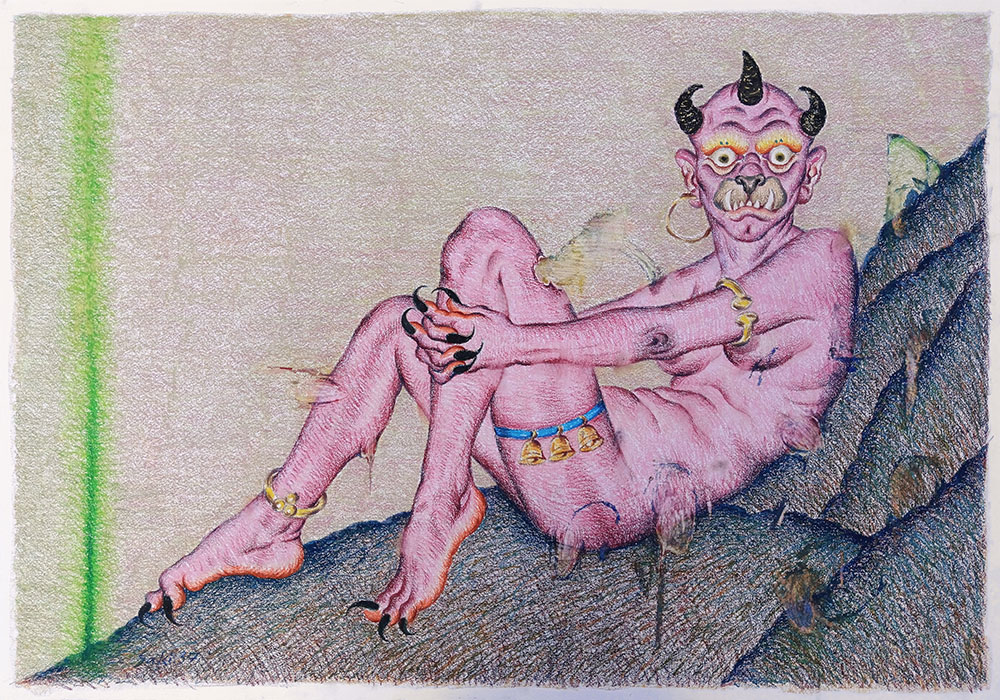
Mahmoud Saki
The Pink Succubus, 2026
Oil Pastel on Paperboard
70 x 100 cm
1540 CAD | 960 € | 830 £
$1,093.00 USD
 Sold | – |
|---|
Out of stock
100% of proceeds go to the artist.
Certificate of Authenticity included.
Shipping timeline: approximately 3–6 months.
Payment details confirmed after inquiry.
Mahmoud Saki is an emerging Iranian painter, draughtsman, and graphic designer. He was born in 1988 in Dorud, Lorestan Province, Iran. He developed a passion for drawing at an early age and devoted himself to daily artistic practice throughout his childhood. During his teenage years, he pursued a more rigorous study of drawing and painting techniques. He holds a B.A. in Visual Communication from the University of Tehran. After moving to Tehran in 2006 to begin his university studies, he has lived and worked there ever since.
Driven by a deep appreciation for beauty and creativity, together with perseverance, dedication, and an experimental spirit, Saki has developed extensive experience across a broad range of artistic and design disciplines.
His work has been exhibited in more than 30 group exhibitions in Iran and internationally and has received recognition in various art competitions. His professional record includes participation in the Bonhams Online Auction: New Day – New Wave (London, 2021), CosMoscow Art Fair (Moscow, 2024), and Tehran Art Fair – Episode 1: Open Paper (Tehran, 2025). Since 2015, he has also presented four solo painting exhibitions in Tehran.
Mahmoud Saki is a painter whose practice encompasses a remarkably wide range of approaches, marked by an impressive ability to move between distinct styles and visual registers. This versatility emerges from both his capacity for and his sustained commitment to painting. Across this stylistic diversity, it is his treatment of color that functions as a constant and unifying force. In Saki’s work, color is neither decorative nor merely subordinate to form; it constitutes a fundamental structural layer, one that independently carries the image’s meaning, rhythm, and energy. In many of his paintings, color is the conceptual point of departure as well as the primary vehicle of expression. It is precisely this chromatic sensibility that lends his work a recognizable coherence and identity, even as style and subject shift.
The works presented in the Continuum initiative are drawn from two of Saki’s best-known series, Flowers and Demons. In both, color operates not only as a structural and aesthetic element, but also as a means of cognition. The two series also share a methodological approach to the production of meaning—one that can be understood in relation to the philosophical logic of the Pre-Socratics. Faced with the multiplicity of perceptible phenomena, the Pre-Socratic philosophers sought an underlying principle or fundamental substance operating beneath appearances, from which those appearances emerge.
Saki adopts a comparable mode of inquiry in Flowers and Demons. He, too, begins with appearance—the flower in one series, the demon in the other—but appearance is never his endpoint. It becomes a surface through which one must pass in order to reach the concealed concept beneath it. The difference between Saki and the Pre-Socratic philosopher lies not in the structure of the inquiry, but in the means through which the underlying principle is approached. The philosopher arrives at it through reasoning and abstraction; Saki arrives at it through the act of painting itself.
In Flowers, this movement takes place through reduction and erasure. The image is constructed only to be progressively removed, blurred, or worn away. It is within this very process of subtraction that a hidden principle begins to emerge: the instability of perception, the transience of life, the presence of time. In Demons, by contrast, the same movement is enacted through accumulation and intensification. The hybrid figures and their direct, invasive presence disclose another underlying principle: the structural conditions that make the emergence of evil possible. In this sense, Saki operates much like a philosopher in pursuit of concepts, with a crucial distinction: his thinking does not take place through conceptual language, but within the material and visual language of painting itself.
It is ultimately this dimension that gives Saki’s Flowers and Demons a significance beyond visual achievement alone. In his practice, painting functions not simply as a means of representing the world, but as a means of thinking through it. This subtle shift has a fundamental consequence: painting moves beyond a purely aesthetic status and assumes an epistemic one. It becomes not merely something to be seen and experienced, but a cognitive and epistemological practice—one capable of producing new forms of knowledge about the world. Saki activates this epistemic potential not through theoretical propositions or declarative statements, but through the material operations of painting itself. The paintings therefore do more than offer images to the viewer; they construct a mode of inquiry through which another understanding of the world can become possible.
ARTWORK PREPARATION
Every artwork is shipped according to its location.
For the safety of the artwork and to facilitate international transportation, works located in Iran are professionally rolled and packed in archival shipping tubes. Paintings on canvas are carefully removed from their stretcher bars prior to shipment and should be professionally re-stretched and framed upon arrival.
DELIVERY TIMELINE
Our current estimated delivery time for works shipped from Iran is 3–6 months, although some orders may arrive sooner depending on the availability of shipping arrangements.
Some artworks are already held by our partner galleries outside Iran and are available for immediate shipment. Where applicable, the artwork page will indicate Immediate Shipping Available, along with the Country of Dispatch.
SHIPPING COSTS & COORDINATION
Shipping is coordinated separately following the purchase of the artwork and is not included in the artwork price. Shipping costs, insurance, customs duties, and any applicable import taxes are the responsibility of the purchaser.
When the artwork is ready for dispatch, our team will contact the purchaser to coordinate shipment based on the shipping options available at that time. The applicable shipping cost will be communicated to the purchaser prior to shipment.
For complete details regarding shipping procedures, international logistics, customs, and purchaser responsibilities, please refer to our Shipping Policy.