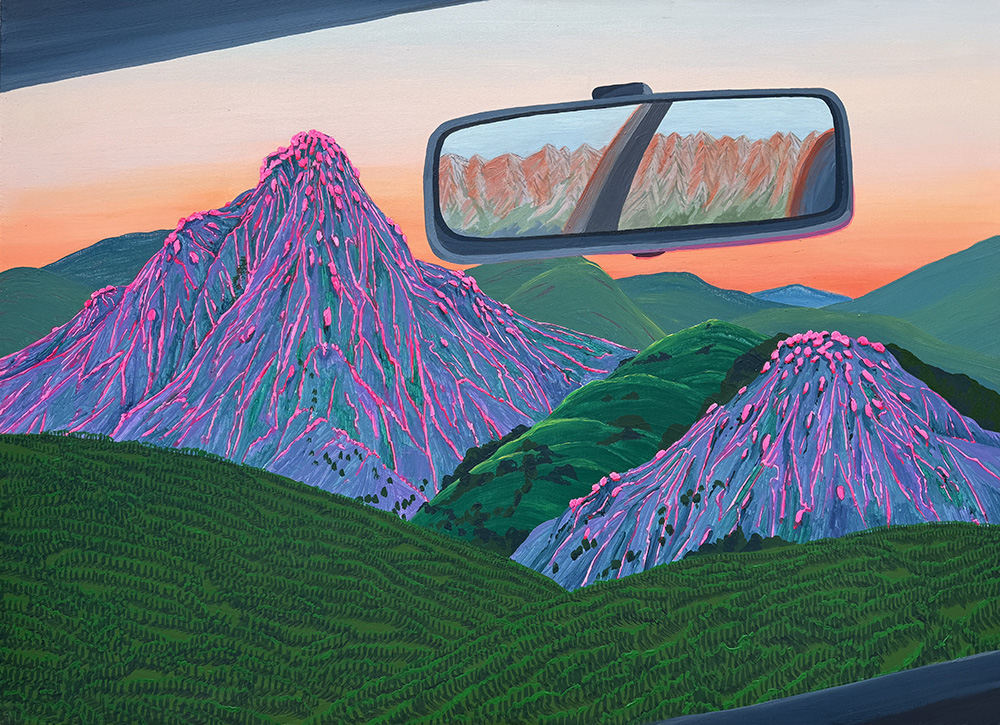

Hannaneh Jaloo (b. 1995) is an Iranian painter born in Tehran. Her practice centers on mountains, fractured perspectives, and winding lines, forming a distinctive visual language rooted in personal memory and landscape. She has held six solo exhibitions across Shiraz, Tehran, and Anzali. Drawing inspiration from the mountains and natural scenery of Iran, Jalo translates her inner visions—long cultivated through line—into dynamic compositions. The memories of roads, driving, and her journeys through mountainous terrains continue to fuel her artistic path, sustaining an ongoing, passionate engagement with painting.
ARTIST REPRESENTATION
Hannaneh Jaloo is exclusively represented by  , which has generously waived its gallery commission for this initiative so that 100% of artwork proceeds go directly to the artist.
Hananeh Jaloo’s landscapes belong to a tradition in which landscape is a matter of stylization rather than the recording of nature: it is constructed through convention. In Persian miniature painting, figures dominated the composition, while the background served only to suggest an environment. These scenes were idealized rather than derived from observed nature. During the Ilkhanid period, contact with Chinese landscape painting introduced stylized rocks and mountains, sometimes rendered with a double outline, into Persian painting. Yet miniature painters detached these elements from their original context and reorganized them within their own compositions. The mountain in Persian miniature was a learned and transferable element, a sign of a mountain rather than the depiction of any particular one.
Jaloo’s mountains are constructed according to the same logic. Their masses emerge from superimposed bands of uniform linear forms that ascend toward the summit. A bright outline separates the mountains from the sky, while the colors—purple, fluorescent pink, and jade green—abandon any reference to the actual hues of rock and earth. In these paintings, the mountain is constructed through the repetition of a pictorial unit; it is therefore made before it is seen.
The painting Rearview Mirror connects this stylization to the problem of seeing. Dark bands at the top and bottom form the frame of a car window, while the mirror reflects a mountain range left behind the viewer. The entire scene is immersed in the light of dusk. This structure has a long history.
In the eighteenth century, tourists drawn to the Picturesque turned their backs on the landscape to view it through a small, darkened mirror known as a Claude glass: a framed view with a simplified palette and the light of dusk. From the advent of the railway onward, landscape became something viewed through the mediation of a machine, something one passed through rather than inhabited.
In a car, the road is both an instrument of vision and the object being seen. In this painting, the landscape is mediated twice: first by the glass and the mirror, and then by the painterly pattern.
From this perspective, landscape in Jaloo’s work is less a genre than a medium. The question is not what landscape means, but what it does and how it organizes vision. In none of these paintings does the mountain appear unmediated. In one, it is constructed through a recurring linear pattern. In another, the frame of the car window and the rearview mirror crop it and consign it to the past. In yet another, a tree trunk in the foreground intervenes between the viewer and the mountain. Landscape in these works is always seen from somewhere: from inside a car, from behind an obstruction, from a distance. What is represented, therefore, is less the mountain itself than the viewer’s relationship to it. This is a viewer who passes through the landscape, frames it, and claims it as their own through visual appropriation, without ever inhabiting it.