Hamed Ghajarpour
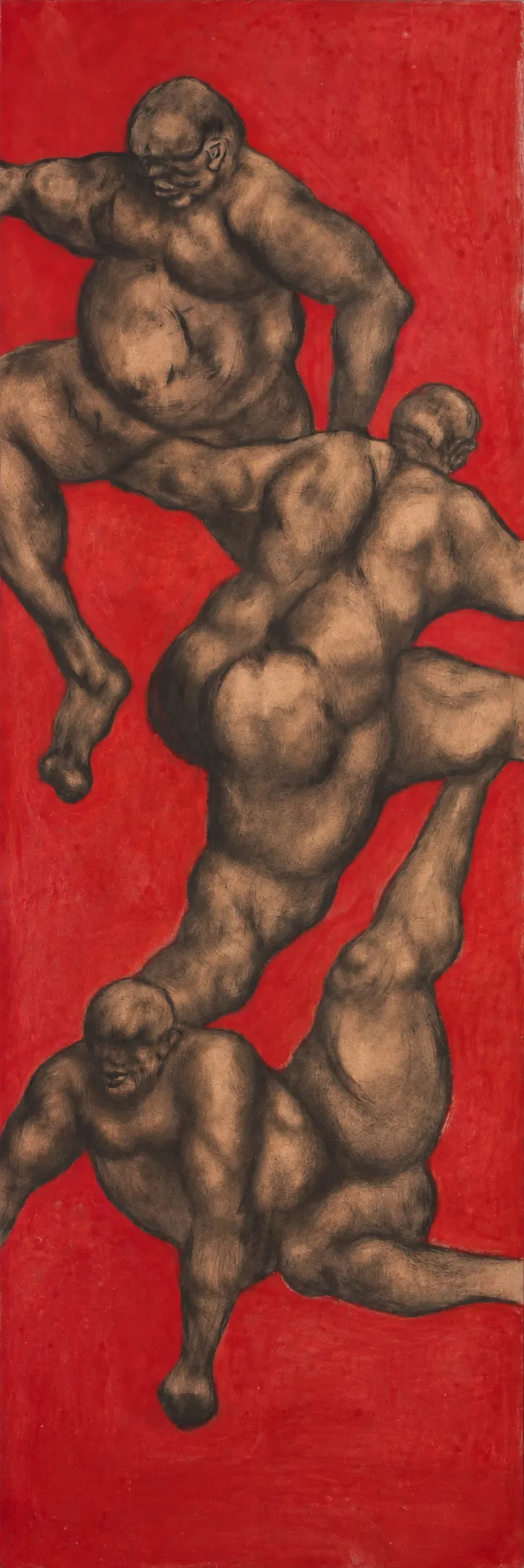
Untitled, 2024
Oil on Fibreboard
90 x 30 cm
450 CAD | 280 € | 240 £
$320.00 USD
 Available | – |
|---|
1 in stock
100% of proceeds go to the artist.
Certificate of Authenticity included.
Shipping timeline: approximately 3–6 months.
Payment details confirmed after inquiry.
Hamed Ghajarpour Nobandegani (born 1986 Fasa, Iran) is a graduate of painting and a visual artist active in the fields of drawing, painting, photography, and fiber art.
His works explore the presence of humans in life, portraiture and figures, mythology and death, as well as architectural and indigenous elements.
His works have been exhibited in galleries in Shiraz, Bushehr, Isfahan, and Tehran and are held in private collections in Iran.
Hamed Ghajarpour’s paintings and sculptures can be read as continuations of one another, as though a single preoccupation were being reiterated and displaced across two media. On the canvas, the body emerges as a cohesive biological mass—a flesh animated not by death, but by a raw sense of vitality and movement: vulnerable and susceptible to pain, yet simultaneously charged with colour and improvisation. Bodies twist into and overlap with one another, so that the figures appear less as stable forms than as bodies caught in the midst of movement or descent—a mass without the composure or stability of a still body.
What is articulated in the paintings through colour and surface becomes, in the woven sculptures, an actual three-dimensional material presence. Where the biological mass of the body in the paintings obscures the legibility of individual limbs through its multiplicity of angles, the sculpture brings to the surface something that would ordinarily remain concealed beneath the skin, within the abdominal cavity. Suspended from the wall, it is placed directly within the viewer’s field of vision. These two operations—the shifting legibility of the painted mass, which changes according to the angle from which it is perceived, and the translation of that same mass into a physical, three-dimensional form—both dislodge the body from any clear or singular definition, but at different levels. In the paintings, ambiguity emerges through the act of looking: in the way the body is read and its movement apprehended. In the sculpture, ambiguity no longer resides in the viewer’s gaze but in the material itself. However it is approached, the woven mass retains, as a physical object, the same biological and indeterminate condition.
The woven sculpture can be considered more closely in relation to what is ordinarily meant to remain concealed within the body. Its convoluted, tubular form, suspended from above and descending downward, gestures toward this hidden interior without precisely representing any particular internal organ. Suspension performs a dual function. On one level, it makes the physical weight of the material perceptible: unlike paint on canvas, thread and knots have weight and yield to gravity, so that their weight is not merely seen but becomes sensorially present. At another level, what remains of the body is no longer the recognizable form of an organ, but a formless mass of flesh. This formlessness renders visible a process of transformation in which the human becomes matter: a body that was once a subject, once suspended and exposed to the viewer’s gaze, becomes an object for the other’s looking. It is at this point that being-for-itself gives way to being-for-another; through the gaze of the observer, the subject is reduced to an object.
Ghajarpour’s treatment of the body can be situated against a historical tradition in which the human body has repeatedly been rendered as flesh through its proximity to the animal carcass—a tradition extending from sixteenth-century Flemish butcher-shop paintings to Rembrandt’s carcass of beef and Soutine’s flayed ox, and reaching a particular intensity in Bacon, where the human figure is placed directly alongside the animal carcass and rendered within the same chromatic field. In these works, the animal provides a mediating presence through which the human body can be apprehended as matter. In Ghajarpour’s paintings and sculptures, however, this intermediary is absent. The body requires no comparison with the carcass in order to become mass and object; its own condition—without external metaphor or allegory—is sufficient.
From this perspective, the difference between the two media is not merely technical, but concerns the mode through which the body comes into presence. In the paintings, the body becomes material mass through a disruption of pictorial legibility; in the sculpture, this condition moves beyond the representational surface and is enacted within matter itself. In both, the body remains suspended between subject and object, between surface and interior, and between life and matter.
ARTWORK PREPARATION
Every artwork is shipped according to its location.
For the safety of the artwork and to facilitate international transportation, works located in Iran are professionally rolled and packed in archival shipping tubes. Paintings on canvas are carefully removed from their stretcher bars prior to shipment and should be professionally re-stretched and framed upon arrival.
DELIVERY TIMELINE
Our current estimated delivery time for works shipped from Iran is 3–6 months, although some orders may arrive sooner depending on the availability of shipping arrangements.
Some artworks are already held by our partner galleries outside Iran and are available for immediate shipment. Where applicable, the artwork page will indicate Immediate Shipping Available, along with the Country of Dispatch.
SHIPPING COSTS & COORDINATION
Shipping is coordinated separately following the purchase of the artwork and is not included in the artwork price. Shipping costs, insurance, customs duties, and any applicable import taxes are the responsibility of the purchaser.
When the artwork is ready for dispatch, our team will contact the purchaser to coordinate shipment based on the shipping options available at that time. The applicable shipping cost will be communicated to the purchaser prior to shipment.
For complete details regarding shipping procedures, international logistics, customs, and purchaser responsibilities, please refer to our Shipping Policy.