Elham Issari
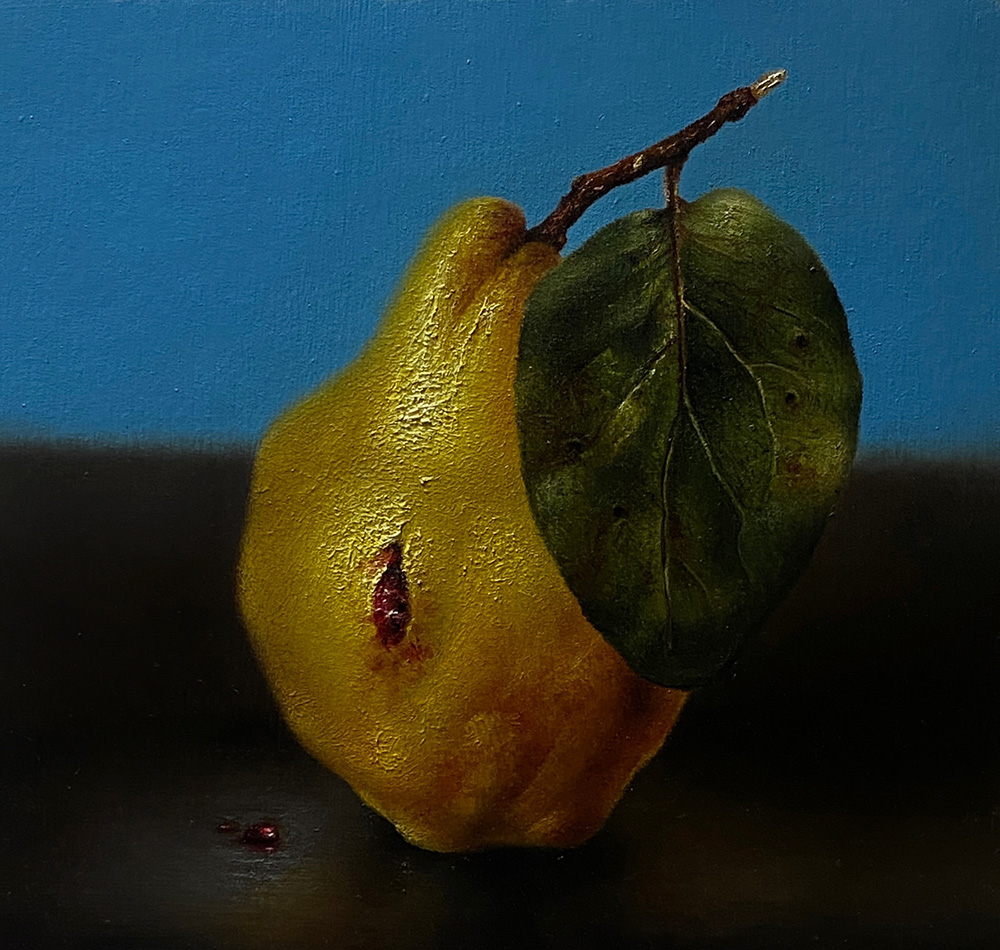
This Year’s Harvest, 2025
Oil on Canvas
20 × 22 cm
1410 CAD | 880 € | 760 £
$1,000.00 USD
 Available | – |
|---|
1 in stock
100% of proceeds go to the artist.
Certificate of Authenticity included.
Shipping timeline: approximately 3–6 months.
Payment details confirmed after inquiry.
Elham Issari (b. 1987, Tehran) is an Iranian painter whose practice explores the psychological dimensions of the human condition through a deeply material engagement with paint. Raised in Tehran, Issari graduated with Honours from the University of the Arts London. Working primarily in oil, she combines close observation and figuration with an intensely tactile approach to the medium, allowing impasto, texture, gesture and the physical accumulation of paint to remain integral to the image. Her paintings often move between the familiar and the uncanny, using the body, animals and everyday objects as vessels for states of memory, vulnerability, alienation and psychological tension. Her practice has been recognised with the Grand Prize of Iranian Contemporary Painting for her Lands series, and her work was featured in Chelsea’s “Best of the Decade.”
Elham Issari studied painting at the University of the Arts London and works within a tradition in art history, namely the School of London, in which thickly applied paint and impasto are not merely descriptive tools but carriers of meaning in their own right. It is a tradition in which psychological dimensions are considered alongside the formal aspects of the work—something that can also be seen in Elham’s paintings.
In the painting Azargun, included in the Continuum Initiative, this idea can be seen in a specific work. At the moment of the animal’s leap, from the midpoint onward, its body transforms from dense flesh into a raw, dispersed texture; that is, paint here does not merely describe form, but depicts the very process of disintegration. This formal decision is inseparable from the psychological dimension of the work. A moment that would ordinarily signify the power and control of an animal body becomes here a moment in which that body also loses its solidity. Form becomes the site where a psychological state takes place, rather than merely a reflection of it.
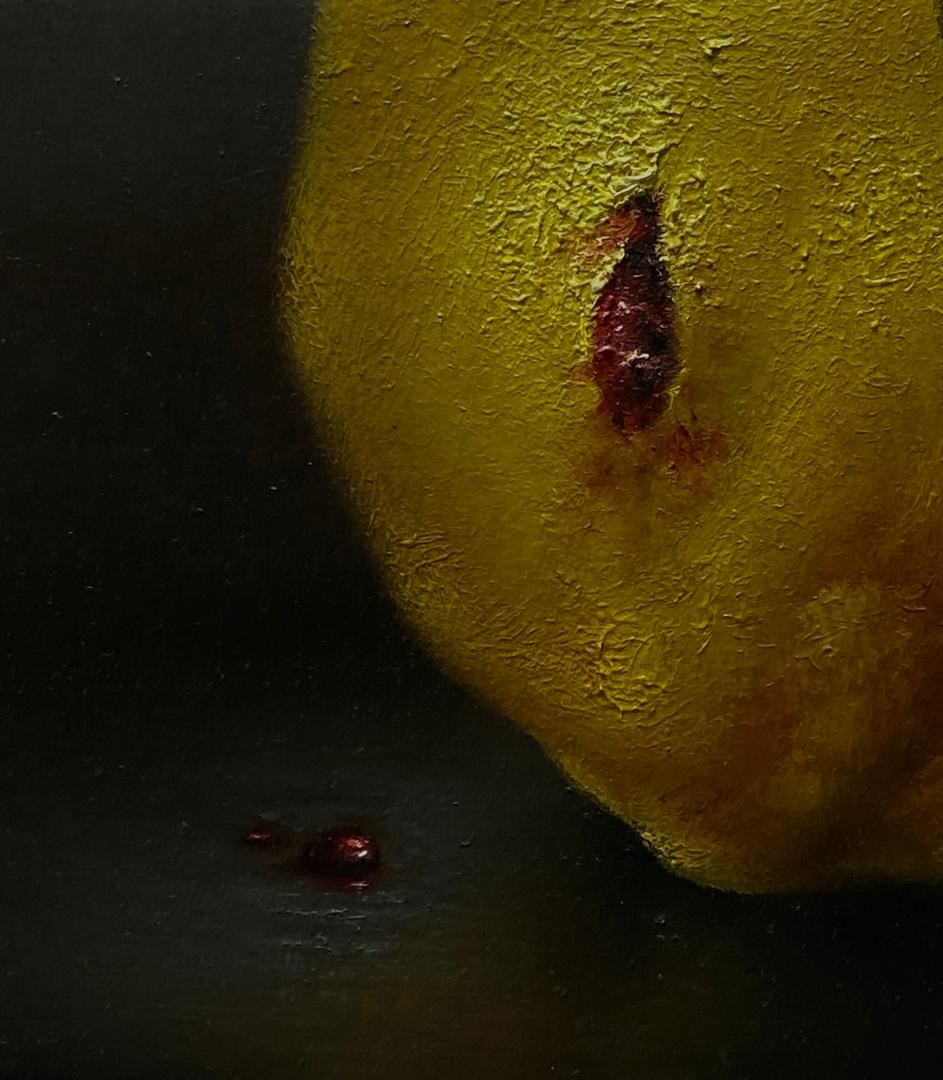
In the painting This Year’s Harvest, this relationship between form and psyche is handled with greater subtlety. The surface of the quince is painted as flawless and smooth; here, paint assumes the task of conveying perfection. Yet within this perfection lies an open wound stained with a deep red, positioned not in a corner or at the margins, but in the central, illuminated part of the fruit. This contrast between the immaculate smoothness of the skin and its incision transforms the wound from a superficial injury into a sign of something deeper. The fruit’s apparent health itself becomes a covering for an injury that comes from elsewhere. If, in the horse, it was the disintegration of the painted texture that carried the psychological state, here it is the contrast between the perfection of the surface and the depth of the wound that performs the same function. The wound does not appear on the fruit simply to damage it; it reveals something that has always been concealed beneath that smooth surface.
What becomes significant in Elham’s paintings is not merely the presence of signs of injury, wounds, or disintegration, but the way in which psychological states take shape within the very pictorial structure of the work. In Issari’s paintings, the psychological is not a subject added onto the image; it occurs through material, surface, and the organization of form. Paint sometimes gives the body solidity through its accumulation and density, and at other times undermines that solidity through rupture and dispersion; a surface that appears complete can conceal a wound, while that same wound can call its apparent order into question. In this sense, for Issari, painting does more than represent a psychological state; it also becomes the site in which that state takes place.
ARTWORK PREPARATION
Every artwork is shipped according to its location.
For the safety of the artwork and to facilitate international transportation, works located in Iran are professionally rolled and packed in archival shipping tubes. Paintings on canvas are carefully removed from their stretcher bars prior to shipment and should be professionally re-stretched and framed upon arrival.
DELIVERY TIMELINE
Our current estimated delivery time for works shipped from Iran is 3–6 months, although some orders may arrive sooner depending on the availability of shipping arrangements.
Some artworks are already held by our partner galleries outside Iran and are available for immediate shipment. Where applicable, the artwork page will indicate Immediate Shipping Available, along with the Country of Dispatch.
SHIPPING COSTS & COORDINATION
Shipping is coordinated separately following the purchase of the artwork and is not included in the artwork price. Shipping costs, insurance, customs duties, and any applicable import taxes are the responsibility of the purchaser.
When the artwork is ready for dispatch, our team will contact the purchaser to coordinate shipment based on the shipping options available at that time. The applicable shipping cost will be communicated to the purchaser prior to shipment.
For complete details regarding shipping procedures, international logistics, customs, and purchaser responsibilities, please refer to our Shipping Policy.