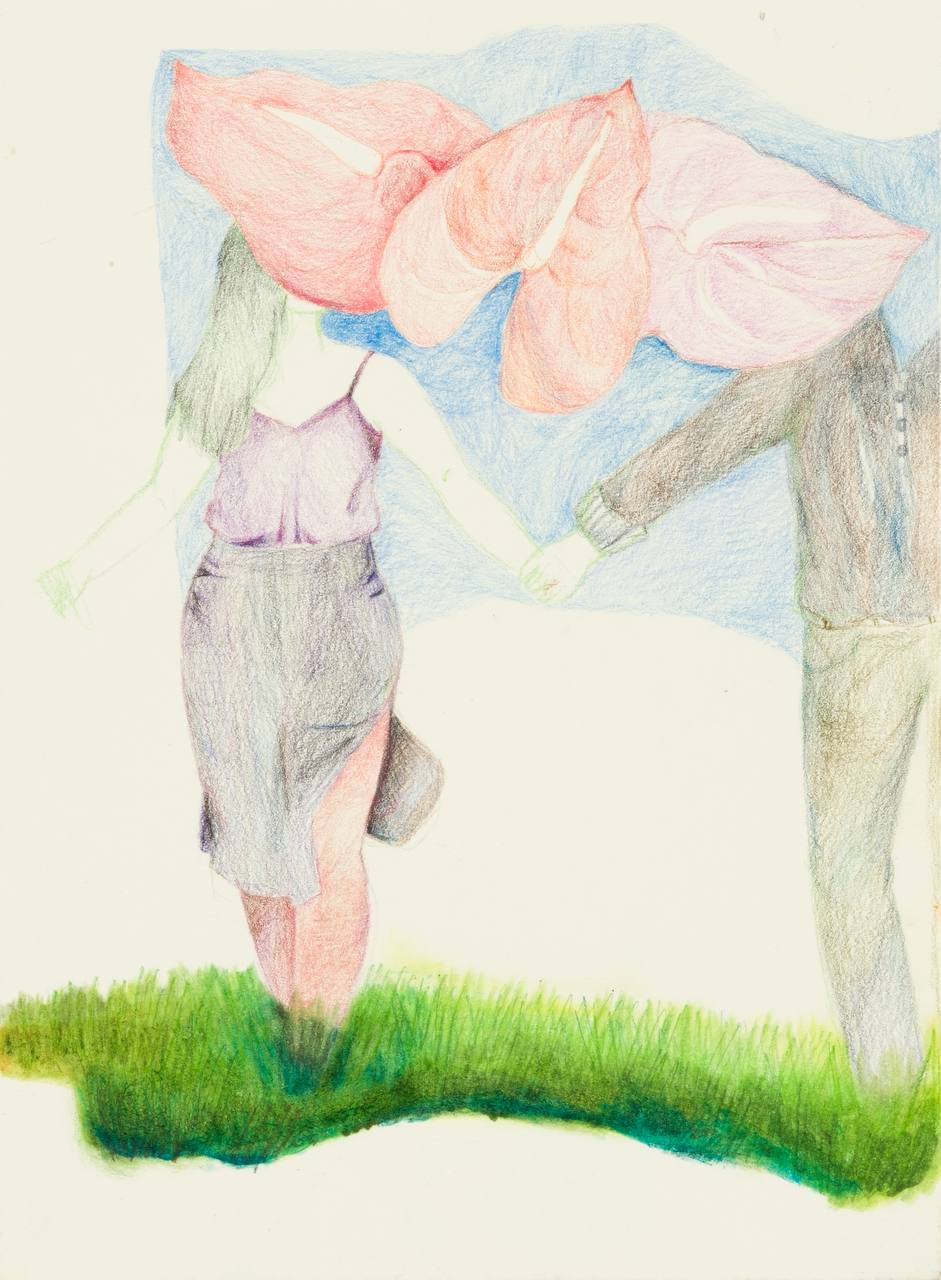
Azarakhsh Asgari
Untitled, 2019
Colored Pencil on Cardboard
21 x 15 cm
515 CAD | 321 € | 277 £
$365.00 USD
 Available | – |
|---|
1 in stock
100% of proceeds go to the artist.
Certificate of Authenticity included.
Shipping timeline: approximately 3–6 months.
Payment details confirmed after inquiry.
Azarakhsh Asgari (b. 1982, Tehran) is an Iranian painter who lives and works in Tehran. For more than two decades, she has maintained a continuous painting practice, one that does not aim to fully represent the world, but to live within its incompleteness. Her work ranges from figurative compositions to still lifes and semi-abstract spaces, where distance — between gaze and subject, between memory and the present — is never concealed, only made visible.
Asgari has held three solo exhibitions: An Odd and Strange Autobiographical Habit (curated by Maryam Majd, O Gallery, Tehran, 2021), a solo show at O Gallery (Tehran, 2017), and a solo show at Dey Gallery (Tehran, 2007). Her work has also been presented in numerous group exhibitions in Iran and abroad.
Alongside her artistic practice, Asgari has pursued a parallel career in art management. She began with a collaboration at Assar Art Gallery, followed by her involvement in Maryam Majd’s artistic projects. In 2017, she founded Art Shop Tehran, and for many years now has worked as an archivist and manager of art collections. Throughout these years, painting has remained at the center of her practice — not merely as a profession, but as a way of thinking and inhabiting the world.
Azarakhsh Asgari paints life: still lifes, familiar interiors, and people who seem to have crossed our paths before; everyday life and its ordinary events. Yet there is something in Asgari’s work that demands closer attention, something that holds the gaze from the very first encounter. Look a little more closely, and you begin to sense that the painter has selected these images from within a larger picture: a chosen moment in life, one image among many, singled out in order to linger a little longer over the everyday. It is as though she were searching for a fragment that might make the world bearable, meaningful, and intelligible. This search for ways to make the world bearable brings us to a word we hear more often these days than ever before: resilience.
Over the past few years, the political and social conditions in Iran have placed such a strain on everyone that resilience has become a recurring refrain in much of what we do. From exercising and making art to carrying out the tasks of everyday life, each has, in its own way, become a means of resilience. Yet the resilience Asgari speaks of, while encompassing these dimensions, is not confined to them. She speaks of something more fundamental, more inward, and more deeply human; something closer to the depths of our human existence: our capacity to endure the world as beings who suffer and whose existence is oriented toward death.
In Asgari’s work, this resilience does not begin from some elevated vantage point. It begins neither with the grand events of history nor with acts of heroism, but at the very level of life that usually escapes notice: a bowl of fruit on a table, a candle in a candlestick, a familiar room, two people standing side by side. To paint these small things is to paint the material foundations of life, the very things that conventional notions of importance habitually overlook: domestic routines, simple rituals of being together, and objects handled every day yet scarcely seen. What unfolds at this level is far from insignificant, for it is here that life, with all its hardships, continues anew each day; as though these were the very things that remain within our reach. Asgari’s attention to everyday life is thus a particular kind of attentiveness: standing before what others have passed by and restoring its weight.
It is at this very level that resilience acquires another meaning. When the structures that organize our lives lie beyond our control, endurance takes the form not of open confrontation but of an art of making do with what is available: rearranging the very fragments we have and creating a place to inhabit within an order imposed upon us by others. Asgari’s paintings do much the same. They do not reconstruct the world; they select a fragment from a larger picture and make, from that fragment alone, a place where one can remain. Resilience in these works is not a claim to have triumphed over these conditions. It is the capacity to live within them without surrendering everyday life to them entirely.
To refuse to surrender everyday life to these conditions does not mean remaining untouched by them. Their weight is present in the works themselves, in a suffering that the apparent tranquility of the images cannot dispel. This suffering does not appear as catastrophe; instead, it settles into the details: in faces that never quite meet, in a candle that remains unlit, and in a piece of fruit left untouched. Asgari neither conceals this suffering nor allows it to engulf the entire image. Faced with a world that cannot be changed, she returns to that fragment which can still be seen, that place where one can still remain. In the end, resilience in her work consists in this continual return to the act of looking: knowing that all things must come to an end, and yet choosing, once again, to look a little longer.
ARTWORK PREPARATION
Every artwork is shipped according to its location.
For the safety of the artwork and to facilitate international transportation, works located in Iran are professionally rolled and packed in archival shipping tubes. Paintings on canvas are carefully removed from their stretcher bars prior to shipment and should be professionally re-stretched and framed upon arrival.
DELIVERY TIMELINE
Our current estimated delivery time for works shipped from Iran is 3–6 months, although some orders may arrive sooner depending on the availability of shipping arrangements.
Some artworks are already held by our partner galleries outside Iran and are available for immediate shipment. Where applicable, the artwork page will indicate Immediate Shipping Available, along with the Country of Dispatch.
SHIPPING COSTS & COORDINATION
Shipping is coordinated separately following the purchase of the artwork and is not included in the artwork price. Shipping costs, insurance, customs duties, and any applicable import taxes are the responsibility of the purchaser.
When the artwork is ready for dispatch, our team will contact the purchaser to coordinate shipment based on the shipping options available at that time. The applicable shipping cost will be communicated to the purchaser prior to shipment.
For complete details regarding shipping procedures, international logistics, customs, and purchaser responsibilities, please refer to our Shipping Policy.