
Alireza Gholami (born 1995, Karaj) is an artist based in Tehran, holding a Bachelor’s degree in Graphic Design with a focus on Illustration. Since 2018, he has been creating handmade fabric dolls, and after moving to Tehran, his practice evolved toward designing and sewing fabric roosters and hens, followed by organic, plant-inspired forms. For Gholami, doll-making extends beyond an experimental craft; it serves as a means of emotional expression and human connection, a perspective that led him to organize interactive events to share this experience with others. His artistic vision is deeply influenced by his proximity to nature and personal experiences. This connection to the natural environment, combined with his interest in fabric as a creative medium, has shaped his distinctive body of work. His creations evoke childhood memories and fleeting moments that persist despite the intensity of urban life in Tehran.
ARTIST REPRESENTATION
Alireza Gholami is exclusively represented by  , which has generously waived its gallery commission for this initiative so that 100% of artwork proceeds go directly to the artist.
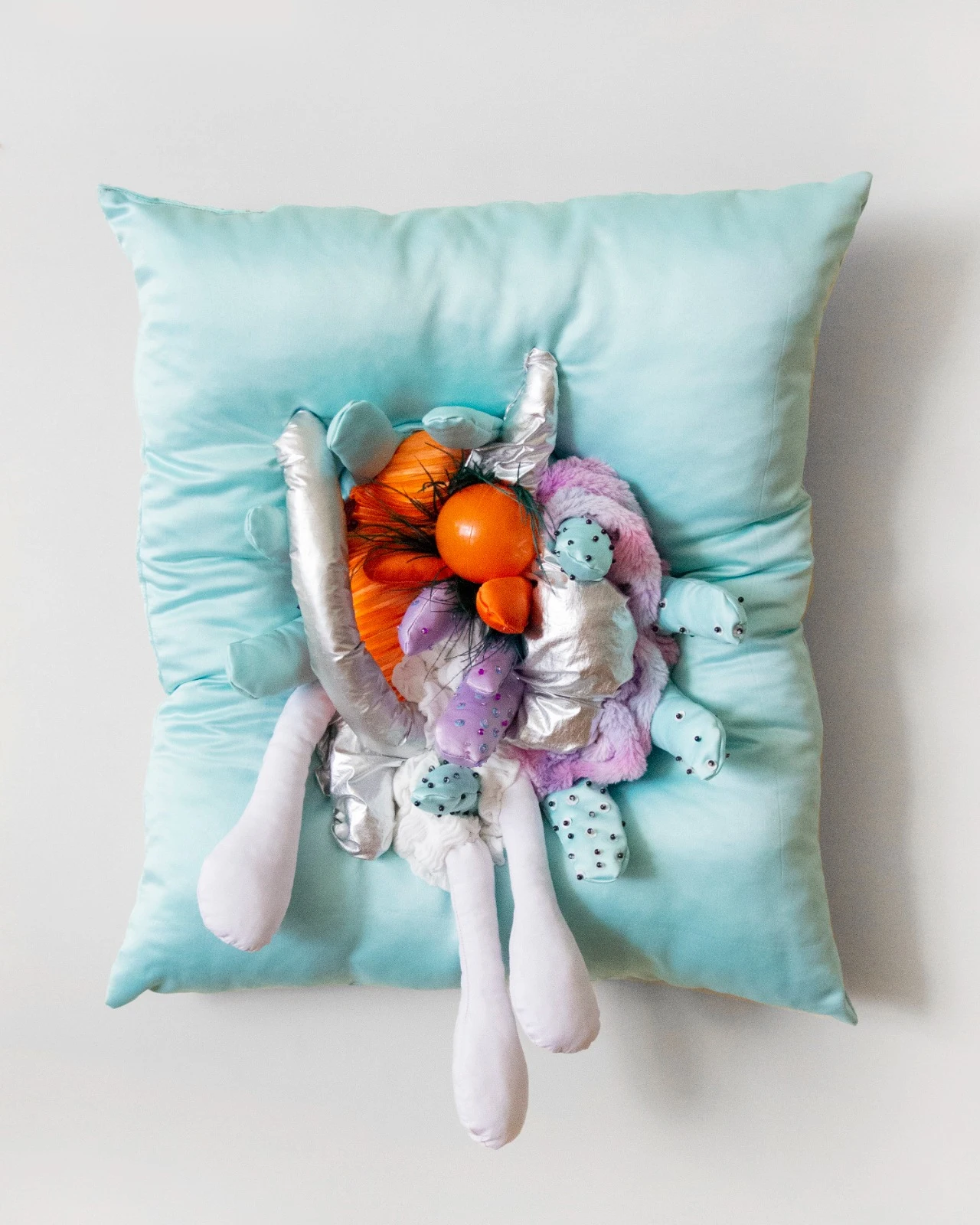
Alireza Gholami’s works are body-like masses: soft, densely clustered volumes formed by the juxtaposition of glossy surfaces, protrusions emerging from the surface, and coloured balls and spheres resting on a cushion-like ground. They are organism-like forms that seem intent on escaping their own boundaries and occupying other surfaces. These masses do not represent any identifiable body. Rather than a face and an anatomically ordered figure, they are composed of bulges, openings, and appendages. It is here that they can be understood as grotesque bodies: bodies that are not separate from the world around them, not closed and completed entities, but unfinished forms that extend beyond their own boundaries.
The significance of such a body lies precisely in the points at which it opens outward, where the world finds its way into the body or the body itself reaches out to meet the world. This body does not remain in a fixed state; it is engaged in a process of becoming. It never reaches completion and continually generates another body out of itself. Its bulges and openings are not the parts of an individual, but the signs of an emergent body that has yet to take shape. At the same time, this is an excessive body, unabashed in its excess and incompatible with any form of authority or restraint. Here, birth and decay are inseparable: every opening may signify both birth and renewal and erosion and death.
Thus, the crucial question that arises in the act of looking at this body is not what it is: whether it is female or male, alive or dead. The right question is what this body will become, and how it will erupt, roar, or disrupt an established order or authority.
The artist’s use of a cushion-like surface to support this unruly, body-like mass is also a pointed irony. A cushion evokes comfort and stillness; it is a surface on which to rest. Here, however, it has become the ground from which chaos and revolt spring forth. What has grown upon this ground refuses the tranquillity expected of it. The repose promised by the cushion has given way to the awakening of a body intent on mobilising everything within its power.
No one has yet determined the limits of this body’s capacities, nor can anyone know in advance what it is capable of doing; these masses seem to have emerged from precisely this uncertainty. This is a body that conforms neither to the mould of the female nor to that of the male. Rather than being defined by what it is, it is defined by what it can do: by its capacity to affect the world and be affected by it, and by its desire to revolt and realise the full extent of its potential.