Ali Manouchehri
Untitled, 2022
Photochemical Print on Silk Photographic Paper
50 × 70 cm
Edition 3 of 10 + 1 AP
494 CAD | 308 € | 266 £
$350.00 USD
 Available | – |
|---|
1 in stock
100% of proceeds go to the artist.
Certificate of Authenticity included.
Shipping timeline: approximately 3–6 months.
Payment details confirmed after inquiry.
Ali Manouchehri is a documentary photographer born in 1994 in Shemiran, living and working in Tehran. His focus has primarily been on urban landscapes, urban character portraits, and urban portraiture. Manouchehri has held one solo exhibition and has participated in various group exhibitions both within Iran and abroad. He has also received the statuette and honorary diploma of the Mohsen Rasoulof Award at the 16th Annual Image Festival.
Ali Manouchehri’s photographs are documentary in the classical sense of the term. They bear witness to events that we have lived through, and continue to live through. Yet this act of witnessing is not direct. It takes place instead through allusions to what is absent from the camera’s frame. In effect, these photographs record an event in its aftermath, and in this sense, they are traces of traces of the event: the marks of hands, slogans written on walls, and whatever else bears evidence of the event’s remnants and of a presence that has passed. But to say that these photographs are made after the event is not to suggest that they arrive too late or stand outside it. There is something in them that is deeply familiar to the Iranian viewer.
What is familiar to the Iranian viewer is the surfaces themselves, even before they become photographs. Walls inscribed with writing at night and painted over by day, only for the inscriptions to reappear on the same layers of paint, are part of the everyday experience of the city. A flag hanging from the facades of public buildings, too, has become so ubiquitous that it is no longer seen. A viewer who has encountered these surfaces in everyday life needs no explanation to understand what has taken place beyond the frame. For this viewer, the event is not a closed chapter of the past; it continues on those very surfaces past which they walk every day. Thus, the fact that these photographs are made in the aftermath of an event creates no distance between the viewer and what has occurred. The photograph summons what the viewer already carries in memory, and it is in this act of summoning that the testimony becomes complete: half of it lies within the frame, the other half in the memory of the one who looks.
What is worth noting here is that one need not necessarily be Iranian to understand these photographs or feel close to them. Human historical memory remains saturated with images of protests, crackdowns, popular movements, and destructive ideologies. Images in which the trace of a bloodied hand or an erased slogan carries a multitude of messages remain alive in the minds of people across the world. One need not be Iranian for memory to complete the photographs; the world’s collective memory summons the half of the photograph that has yet to arrive.
This act of summoning is made possible through a formal choice. In all three photographs, the camera faces the surface directly, and the surface fills the entire frame. The camera adopts a direct, unembellished perspective, drawing attention to the physical surfaces, structures, and traces that occupy the frame.
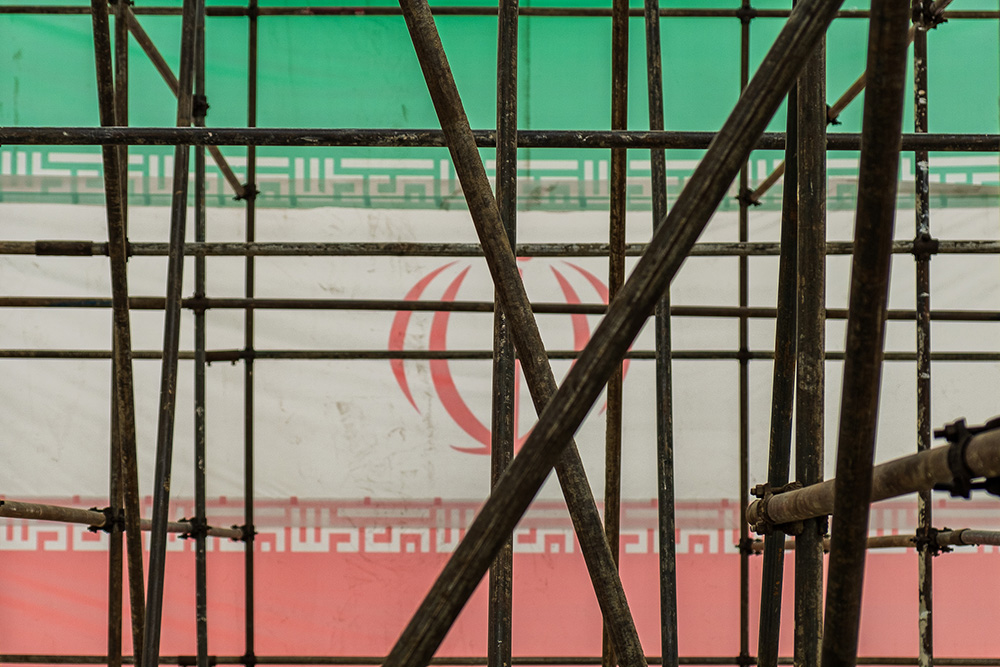
While each composition retains its own sense of spatial depth, the surrounding environment remains largely outside the viewer’s field of vision. Rather than situating these subjects within an expansive landscape, the photographer invites us to examine them in their immediate material and visual presence. This measured, observational approach recalls the documentation of a crime scene more than conventional photojournalism. The photographer does not dramatize anything but presents the surface as it is. Yet this restraint does not amount to neutrality, for each surface bears a distinct sign: a flag behind the scaffolding mesh; an inscription on a layer of white paint spread over an adobe wall; and the traces of countless hands, overlapping one another and running down the wall and the ledge. For this reason, the silence of these photographs does not dissolve into an indistinct mourning for an unnamed ruin. An unnamed ruin can be assigned to any place and any time, but these surfaces are bound to a specific history. It is this connection that dislodges the viewer from the position of a spectator contemplating beautiful sorrow and places them instead in the position of a witness.
ARTWORK PREPARATION
Every artwork is shipped according to its location.
For the safety of the artwork and to facilitate international transportation, works located in Iran are professionally rolled and packed in archival shipping tubes. Paintings on canvas are carefully removed from their stretcher bars prior to shipment and should be professionally re-stretched and framed upon arrival.
DELIVERY TIMELINE
Our current estimated delivery time for works shipped from Iran is 3–6 months, although some orders may arrive sooner depending on the availability of shipping arrangements.
Some artworks are already held by our partner galleries outside Iran and are available for immediate shipment. Where applicable, the artwork page will indicate Immediate Shipping Available, along with the Country of Dispatch.
SHIPPING COSTS & COORDINATION
Shipping is coordinated separately following the purchase of the artwork and is not included in the artwork price. Shipping costs, insurance, customs duties, and any applicable import taxes are the responsibility of the purchaser.
When the artwork is ready for dispatch, our team will contact the purchaser to coordinate shipment based on the shipping options available at that time. The applicable shipping cost will be communicated to the purchaser prior to shipment.
For complete details regarding shipping procedures, international logistics, customs, and purchaser responsibilities, please refer to our Shipping Policy.