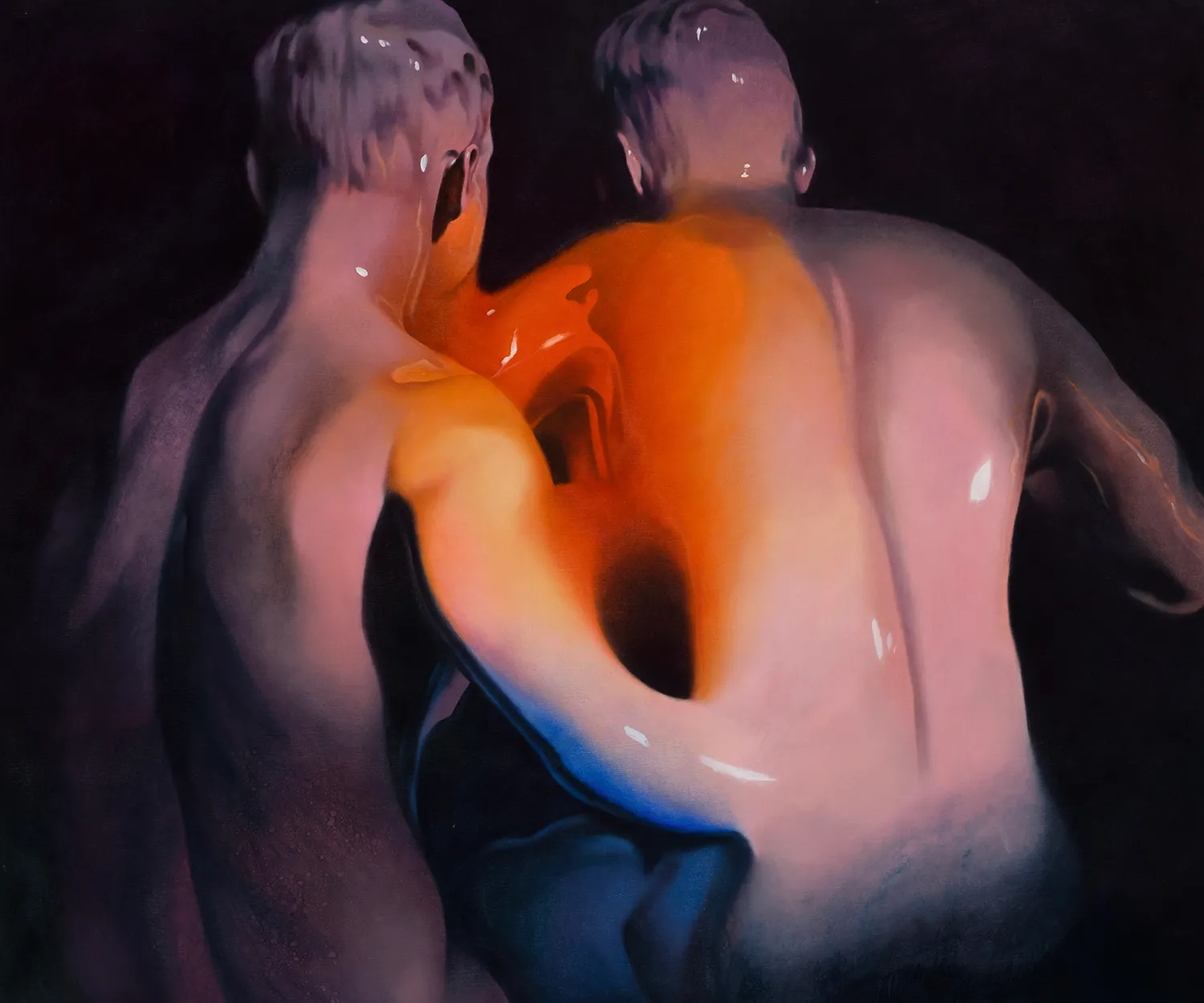
Ali Ganjavi
Untitled, 2025
Oil on Canvas
100 x 120 cm
2050 CAD | 1280 € | 1100 £
$1,480.00 USD
 Sold | – |
|---|
Out of stock
100% of proceeds go to the artist.
Certificate of Authenticity included.
Shipping timeline: approximately 3–6 months.
Payment details confirmed after inquiry.
Ali Ganjavi (b. 1980, Saari, Iran) works much like a poet, constructing rhythmical sequences and subtle units of meaning within carefully calibrated visual structures. His frame-by-frame depictions suspend time, opening space for reflection. While grounded in hyperrealism, his surreal approach to color creates distance—color, for Ganjavi, serves as a narrative device rather than a mere vehicle of representation. By disrupting visual habits and reordering familiar forms, he invites viewers to reconsider interpretation, meaning and truth. In these moments of hesitation, his work underscores the instability of both vision and thought.
Since 2000, Ganjavi has held five solo exhibitions and participated in numerous group shows. His recent presentation at Art Dubai 2025 further expanded his visual inquiry, situating his nuanced explorations of perception and narration within a broader international context.
In Ali Ganjavi’s paintings, skin and color represent two opposing visual regimes that remain in constant tension with one another. Skin, through its precise hyperrealist rendering, promises a contained, recognizable, embodied body, while color—fluid, saturated, and often in the process of dripping—violates this containment and extends beyond the body’s boundaries. Here, color no longer serves a representational function; instead, it becomes a narrative and affective instrument that inscribes the figures’ internal states—suspension, vulnerability, dissolution—directly onto the surface of the body. The result is a body suspended between anatomical solidity and chromatic dissolution: neither fully contained nor fully open.
By disrupting the conventional contour of painting, the artist draws the body out of the framework of the contained subject; the boundary that ordinarily keeps the body distinct from its surroundings, and one body distinct from another, no longer functions as a containing limit. Color crosses the hypothetical boundaries of the figure and spills into the surrounding space, and, in compositions in which two or more bodies are held in an embrace, into the adjacent body. This seepage is not merely a formal choice; it calls into question the premise of the closed and autonomous subject and, in its place, posits a permeable body whose boundary collapses precisely at the moment of contact with the other. In this way, corporeal vulnerability—the body’s inability to contain itself within itself—is represented simultaneously at the level of form and meaning: in the moment of intimacy, the line that individuates the body becomes as unstable as the boundary of color itself.
All of these visual subtleties—the seepage of color, the disruption of the contour, the suspension of time—serve the articulation of a single concept: intimacy. Yet the intimacy this painter depicts is neither simple nor unified; it is layered and at times seems elusive—the closer we come to the moment of connection, the more that moment recedes or dissolves. This recalls something akin to what Jean-Luc Nancy says about proximity and the body: the body exposes itself to the other without its boundary becoming either completely closed or completely erased—what he calls “exposition.” The seepage of color in these paintings can be read as a precise image of this exposition: a suspended boundary between containment and openness. In this sense, intimacy in these works is not a state of tranquility but a liminal condition: it does not occur through the complete erasure of the boundary, but in the moment when the boundary can no longer sustain itself as a definitive boundary.
ARTWORK PREPARATION
Every artwork is shipped according to its location.
For the safety of the artwork and to facilitate international transportation, works located in Iran are professionally rolled and packed in archival shipping tubes. Paintings on canvas are carefully removed from their stretcher bars prior to shipment and should be professionally re-stretched and framed upon arrival.
DELIVERY TIMELINE
Our current estimated delivery time for works shipped from Iran is 3–6 months, although some orders may arrive sooner depending on the availability of shipping arrangements.
Some artworks are already held by our partner galleries outside Iran and are available for immediate shipment. Where applicable, the artwork page will indicate Immediate Shipping Available, along with the Country of Dispatch.
SHIPPING COSTS & COORDINATION
Shipping is coordinated separately following the purchase of the artwork and is not included in the artwork price. Shipping costs, insurance, customs duties, and any applicable import taxes are the responsibility of the purchaser.
When the artwork is ready for dispatch, our team will contact the purchaser to coordinate shipment based on the shipping options available at that time. The applicable shipping cost will be communicated to the purchaser prior to shipment.
For complete details regarding shipping procedures, international logistics, customs, and purchaser responsibilities, please refer to our Shipping Policy.